.svg)
Riddles to Build Vocabulary in Kids
"What begins with an E but only contains one letter?"
(Answer: An envelope.)
Fun, right? But riddles do more than raise eyebrows or trigger giggles. They're secretly one of the most effective ways to help kids expand their vocabulary. Through clever wordplay and context-based clues, riddles challenge young minds to explore language deeply and creatively.
In today's fast-paced world of screens and instant answers, riddles slow things down and make kids think about words, meanings, and language in fresh, exciting ways.
So... are riddles just word games? Not quite. They're actually powerful tools for boosting vocabulary, enhancing problem-solving, and sparking a lifelong love of language. Let's dive in.
Why Riddles Are Effective for Vocabulary Building
Word Play & Multiple Meanings
Riddles often rely on homonyms and figurative language. This teaches kids that words can have more than one meaning, encouraging flexible thinking.
Example: "What has a face and two hands but no arms or legs?" (Answer: A clock)
Kids learn that "face" and "hands" don't always mean body parts. They can refer to objects too. This kind of wordplay sharpens semantic awareness.
Contextual Clues
Solving riddles forces kids to make inferences based on context. They learn to pick up on subtle language cues and use deductive reasoning to arrive at the correct meaning.
Fun Exposure to New Words
When kids encounter unfamiliar words in the playful context of a riddle, they're more likely to remember them. The brain loves stories and puzzles. It locks onto novelty.
Stimulates Creative Language Use
Riddles encourage kids to experiment with synonyms, metaphors, and figurative language, helping them build expressive vocabulary and refine their writing and speaking skills.
Examples of Riddles That Build Vocabulary
- What has a neck but no head?
Answer: A bottle
Teaches alternate meanings and object vocabulary - What gets wetter as it dries?
Answer: A towel
Introduces paradox and logical inference - What has a head and a tail but no body?
Answer: A coin
Highlights homonyms and symbolic thinking - What begins with an E but only contains one letter?
Answer: An envelope
Explores word structure and lateral thinking - I have branches but no fruit, trunk, or leaves. What am I?
Answer: A bank
Encourages figurative thinking and broadens context understanding
Practical Ways to Use Riddles in Vocabulary Instruction
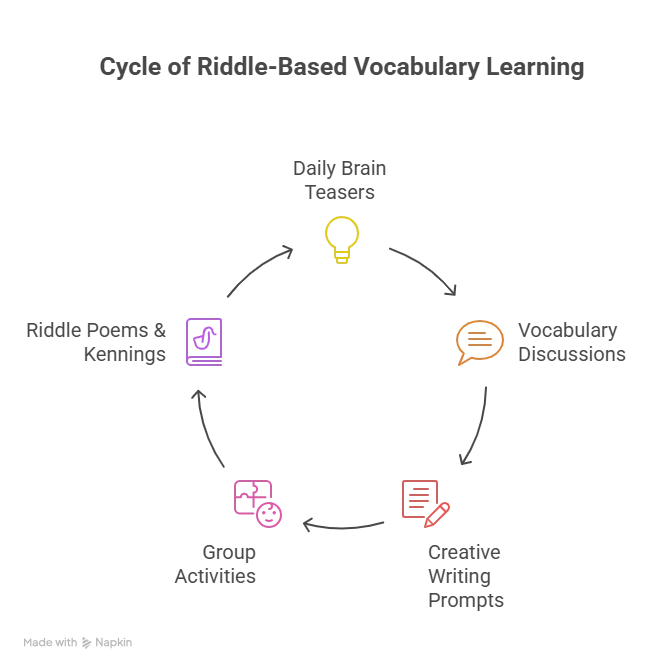
- Daily Brain Teasers: Begin each day or lesson with a riddle. It's a gentle but stimulating way to warm up young brains and sneak in new words.
- Vocabulary Discussions: After solving, take a moment to unpack the language.
- Creative Writing Prompts: Encourage kids to write stories inspired by riddle answers.
- Group Activities: Divide kids into pairs or teams to solve riddles together.
- Riddle Poems & Kennings: Introduce kennings: riddle-like compound nouns from Old English.
Tips for Creating Your Own Vocabulary-Boosting Riddles
- Start With the Answer: Pick a word you want to teach, then write clues based on its shape, function, or unusual traits.
- Use Figurative Language: Don't just describe literally. Use comparisons, exaggerations, and double meanings.
- Keep It Playful: Humor, surprise, and a touch of mystery keep kids engaged.
Recommended Resources for Riddle-Based Learning
- Prodigy Game – Riddles for Kids: Kid-friendly, categorized riddles plus ideas for integration into math and language learning
- Genie Academy – Riddles for Kids: Thoughtfully curated riddles and advice for using them in both school and home settings
- Primary Englished – Riddle with Vocabulary: Deep dive into how riddles promote language skills, with a special focus on kennings
- SplashLearn – What Am I? Riddles for Kids: Perfect for classroom warm-ups or vocabulary units
- Reading Rockets – Playing with Words: Riddles: A literacy-focused take on riddles for building vocabulary, phonemic awareness, and comprehension
Conclusion
Riddles offer more than wordplay. They're a doorway into the magic of language. By mixing laughter with logic, imagination with inference, they help children build rich, lasting vocabularies.
So why not make riddles part of your routine? Whether you're a parent, teacher, or caregiver, just one riddle a day can inspire curiosity, spark learning, and build language power brick by brick.
Final Riddle: What comes once in a minute, twice in a moment, but never in a thousand years? (Answer: The letter M)
Related Questions
- How do riddles enhance vocabulary? They present words in novel, engaging contexts, making them easier to remember and understand.
- Can creating riddles help kids grasp complex words? Absolutely. Writing riddles requires a deep understanding of the word, promoting both clarity and creativity.
- What kinds of riddles teach English language concepts best? Riddles that use wordplay, metaphors, or homonyms help build linguistic flexibility and concept understanding.
- Are riddles better in group or solo activities? Both. Group work builds communication and collaboration, while solo solving sharpens focus and personal expression.