.svg)
Psychology of Children's Riddles
A Water Colouring Painting of Psychology of Children's Riddles
Introduction
There's something timeless about the way children light up when faced with a riddle. Whether it's a playful rhyme or a tricky brainteaser, riddles have an irresistible pull on young minds. They spark curiosity, ignite imagination, and create moments of shared laughter and triumph.
But why do riddles captivate children so deeply? What's happening beneath the surface as they puzzle through these clever challenges?
In this blog, we'll explore the fascinating psychology behind children's riddles. We'll dive into the cognitive, emotional, social, and developmental benefits that make riddles more than just a game; they're a powerful tool for growth. From boosting problem-solving skills and sharpening memory to building resilience and fostering social connections, riddles offer children a rich, playful path to learning.
The Cognitive Power of Riddles
Developing Problem-Solving Skills
At the heart of every riddle is a problem waiting to be cracked. For children, this is more than entertainment, it's a mental workout. Solving riddles challenges kids to think critically, examine information from different angles, and come up with creative solutions.
When a child encounters a riddle, they instinctively begin to:
- Identify the problem or question.
- Consider multiple possible answers.
- Use logic, imagination, and sometimes trial and error to find the solution.
This process requires them to step beyond surface-level thinking. They learn to challenge assumptions, spot hidden clues, and appreciate that some problems don't have obvious answers. Each success builds their analytical abilities and lays the groundwork for flexible, resilient thinking.
Attention to Detail and Memory
Riddles don't just require clever thinking, they demand focus. To solve them, children must carefully listen to or read each word, paying attention to subtle hints that can easily be overlooked. This strengthens their ability to concentrate on small details while keeping the big picture in mind.
As they puzzle through the riddle, kids also practice holding clues and partial answers in their working memory. This active mental juggling sharpens their memory, helping them track pieces of information and stay engaged throughout the challenge.
By regularly tackling riddles, children train themselves to be attentive, patient, and mentally organized—skills that pay off in school, play, and life beyond.
Riddles as Language and Creativity Catalysts
Expanding Vocabulary and Language Skills
Riddles are a playground for language. They often twist words, play with sounds, and rely on double meanings that challenge children to think beyond literal definitions. In this way, riddles become powerful tools for language development.
When children engage with riddles, they are exposed to:
- Wordplay: Puns, rhymes, and clever turns of phrase that make them aware of the flexibility of language.
- Metaphors and double meanings: Riddles teach that words can have more than one meaning, expanding a child's understanding of nuance and symbolism.
By solving riddles, children build richer vocabularies and become more attuned to the subtleties of language. They begin to see language as something playful and dynamic, which helps them develop language proficiency and improves their ability to express complex ideas.
Encouraging Creative and Lateral Thinking
Perhaps the most exciting feature of riddles is their ability to push children to think outside the box. The best riddles require answers that are not obvious; they often hinge on surprise, word twists, or unexpected connections.
Children quickly learn that the solution isn't always what it first seems. This teaches them to:
- Challenge their assumptions.
- Look for abstract or less conventional solutions.
- Enjoy the process of creative discovery.
Through this, riddles become a gentle training ground for lateral thinking, the kind of creative problem-solving that encourages children to connect unrelated ideas in novel ways. This skill not only helps with riddles but also enhances their approach to learning, art, and everyday challenges.
Emotional and Social Dimensions
Emotional Growth Through Riddles
Riddles naturally stir a mix of emotions. Children can feel excited when they're close to the answer, frustrated when they're stuck, and proud when they solve it. This emotional rollercoaster is more than just fun, it's development in action.
Working through these feelings helps children:
- Build emotional resilience.
- Learn to tolerate frustration without giving up.
- Develop confidence when they overcome challenges.
Each solved riddle is a small emotional victory, and over time, these victories strengthen a child's self-esteem and persistence.
Social Interaction and Bonding
Riddles aren't just solo challenges, they are often shared experiences. Whether in the car, at the dinner table, or during playtime with friends, riddles create moments of laughter, teamwork, and connection.
When children solve riddles together, they practice:
- Listening carefully to each other.
- Communicating ideas and possible solutions.
- Collaborating toward a shared goal.
This cooperative problem-solving fosters social bonding and strengthens relationships. Sharing a laugh over a particularly tricky or clever riddle creates joyful, memorable moments that bring children and adults closer together.
Behavioral and Motivational Impact
Riddles don't just challenge children's minds, they also shape their behavior and attitude toward learning. One of the most valuable life lessons riddles teach is persistence. Solving a riddle can be frustrating, especially when the answer feels just out of reach. But with each attempt, children build patience and learn the value of sticking with a problem rather than giving up.
This process naturally encourages:
- Embracing challenges instead of avoiding them.
- Viewing mistakes as part of the journey, not as failures.
- Developing a growth mindset and a belief that effort leads to improvement.
Riddles also tap into a child's innate curiosity. The moment they hear a riddle, most children immediately want to solve it. This curiosity-driven engagement can spark a broader love of learning that goes beyond riddles. When kids are motivated by curiosity, they are more likely to seek out knowledge, explore new topics, and enjoy the process of discovery, an invaluable trait for lifelong learning.
Why Children Solve Riddles Differently from Adults
There's a fascinating psychological twist: children often solve riddles faster than adults. Why? It comes down to the way they think.
Children tend to approach riddles with imaginative, less rigid thinking. They haven't yet built up the layers of assumptions, biases, and fixed interpretations that adults accumulate over time. This freedom allows them to:
- Consider playful, metaphorical, or unexpected answers more easily.
- Make intuitive leaps without overcomplicating the problem.
Adults, on the other hand, often overanalyze riddles, getting stuck in literal thinking or overcomplicating what might actually be a simple solution. They may try to apply learned rules that, in the world of riddles, aren't always helpful.
This difference highlights one of the most remarkable aspects of children's minds: fewer preconceptions can lead to quicker, more intuitive problem-solving. Sometimes, being less experienced can actually be an advantage—especially in the creative, topsy-turvy world of riddles.
Developmental Milestones and Riddle Comprehension
Not all children grasp riddles in the same way, and their ability to understand and enjoy riddles changes as they grow. Developmental psychology shows that a child's age and language proficiency significantly influence how they process riddles.
Age and Humor Comprehension
Research indicates that children generally begin to fully comprehend the humor in riddles around age 8. Before this age, many children can solve simple riddles, but they might not fully appreciate the wordplay or the humor embedded in the twist of the answer.
- Younger children may focus on the literal meaning of words, making it harder for them to "get" the joke.
- By age 8, most children can connect humor with visible emotional reactions like smiling or laughing, showing they truly understand the playful logic behind riddles.
The Role of Language Proficiency
Interestingly, language skills are just as crucial as age. Studies show that children with advanced vocabulary and strong language comprehension tend to solve and enjoy riddles earlier, regardless of their age.
- Exposure to complex words, metaphors, and puns enhances a child's ability to decipher riddles.
- The more language tools a child has, the better they can pick up on subtle clues and wordplay.
In essence, the joy and mastery of riddles evolve with both cognitive maturity and language experience. This developmental pathway makes riddles not just fun, but an excellent gauge of a child's growing linguistic and cognitive capabilities.
Summary: Psychological Benefits of Riddles for Children
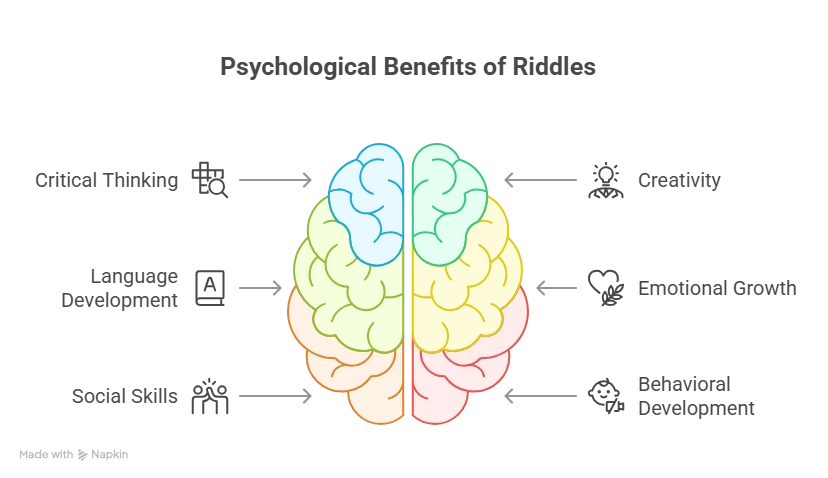
Riddles do far more than entertain. They support a wide spectrum of psychological, cognitive, and social development in children. Below is a summary table highlighting the key benefits:
| Benefit Area | Description |
|---|---|
| Critical Thinking | Analyzing clues, solving problems, considering alternatives. |
| Creativity | Thinking outside the box, embracing abstract and playful ideas. |
| Language Development | Expanding vocabulary, understanding puns, mastering wordplay. |
| Emotional Growth | Building patience, managing frustration, developing confidence. |
| Social Skills | Encouraging teamwork, communication, and shared laughter. |
| Behavioral Development | Fostering persistence, curiosity, and a growth mindset. |
Through riddles, children sharpen their minds, strengthen their social bonds, and build emotional resilience all while having fun. Whether tackled alone or shared in groups, riddles are a deceptively simple but profoundly beneficial part of childhood learning.
Key Resources for Further Reading
For those interested in diving deeper into the psychology of children's riddles, these research articles, educational resources, and videos provide valuable insights:
- The Development of Children's Comprehension and Appreciation of Riddles – ScienceDirect
An in-depth study on how children's ability to understand and enjoy riddles evolves with age and language proficiency. - The Benefits of Riddles in Education – Smile and Learn
A practical exploration of how riddles can support learning in classroom and home environments. - Discover How Riddles Can Improve Your Child's Creativity – Connections Academy
An accessible overview of the link between riddles, creative thinking, and flexible problem-solving in children. - The Role of Riddles in Children's Behavior – Modern Science and Research
A focused analysis of how riddles shape patience, curiosity, and perseverance in young learners. - Riddles: Kids vs. Adults – YouTube
An engaging video demonstration of how children and adults approach riddles differently, showcasing the playful advantage of youthful thinking. - The Development of Children's Comprehension and Appreciation of Riddles – UCL Discovery
Additional research offering developmental milestones related to humor comprehension and language processing in children.
Related Questions
- How do riddles enhance cognitive and emotional development?
Riddles develop critical thinking, memory, and problem-solving skills while also boosting emotional resilience through the experience of success, failure, and playful challenge. - What role do riddles play in creativity?
Riddles push children to think laterally, make abstract connections, and embrace unexpected solutions, fostering creative thinking and imaginative exploration. - How do riddles help build social skills?
Solving riddles together encourages teamwork, communication, and shared humor, strengthening peer relationships and social bonding. - How do riddles foster persistence and curiosity?
Riddles naturally motivate children to keep trying, teaching patience and the value of sticking with a challenge, while sparking curiosity about how things work. - What are the benefits of riddles for language learning?
Riddles introduce children to new vocabulary, complex sentence structures, puns, and wordplay, enhancing language proficiency in a fun, engaging way.
FAQ
At what age do children start understanding riddles?
Most children begin to comprehend and appreciate riddles, especially their humor and wordplay, around age 8. However, language skills also play a key role, so some children may develop this understanding earlier or later.
How do riddles help with children's language development?
Riddles expose children to new vocabulary, metaphors, and multiple meanings of words, which expands their language proficiency and encourages creative use of language.
Can riddles improve a child's social skills?
Yes! Solving riddles in groups encourages teamwork, communication, and bonding, making it a fun way to strengthen social connections.
Why do children sometimes solve riddles faster than adults?
Children often approach riddles with fresh, imaginative thinking and fewer preconceptions, allowing them to see creative or abstract answers more quickly than adults who may overanalyze.
What psychological benefits do riddles offer beyond problem-solving?
Beyond cognitive skills, riddles help children develop emotional resilience, patience, curiosity, and confidence, fostering a growth mindset and a love of learning.